Dedicated Internet Access vs Business Broadband: Which Does Your Office Need?
Carriers sell both as business internet, but only one of them comes with bandwidth reserved for you and a contract that pays when the circuit fails.
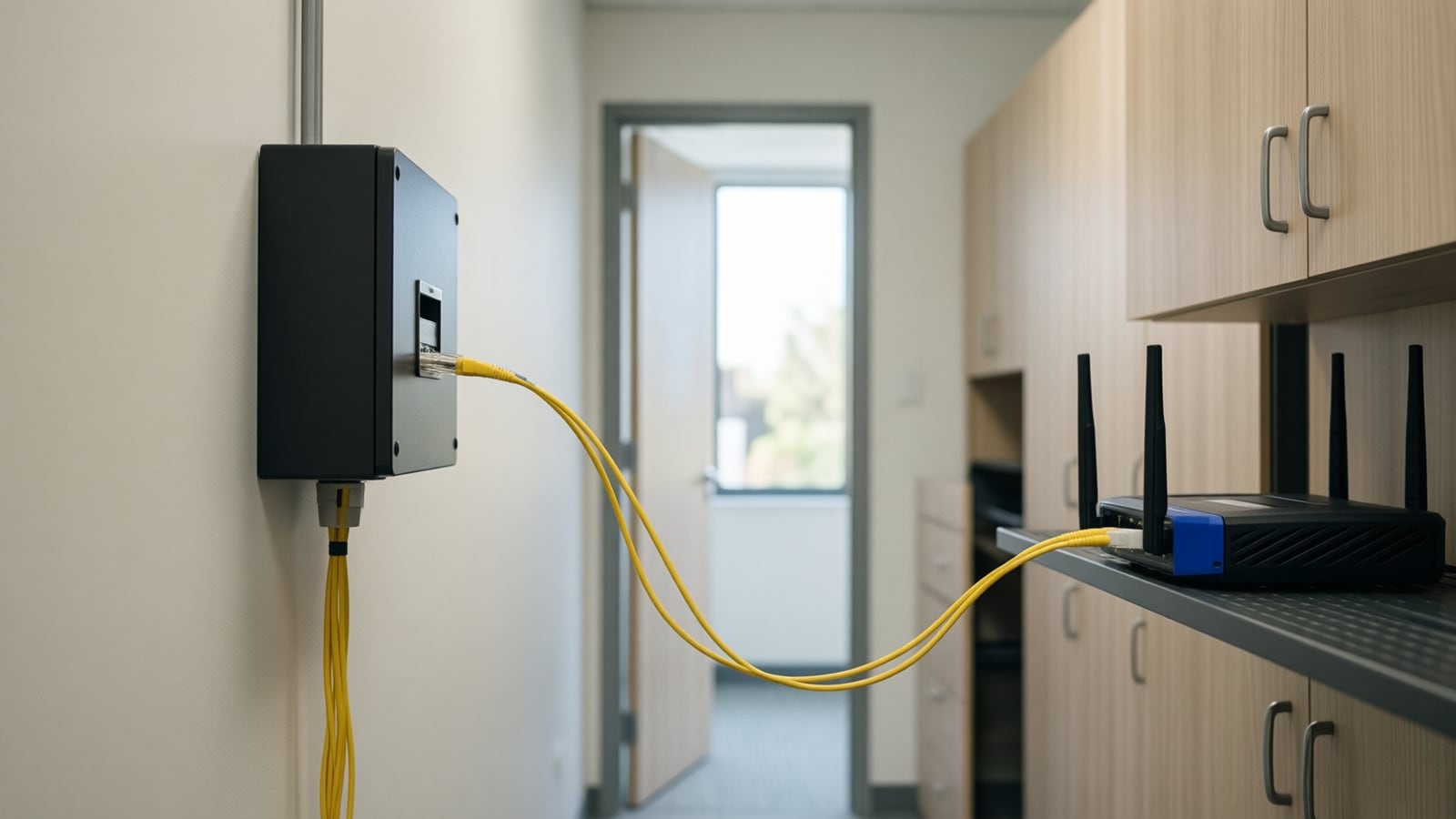
Dedicated internet access (DIA) reserves a circuit's full bandwidth for one customer and backs it with a contract that pays credits when the carrier misses its availability and repair targets. Business broadband shares capacity and promises best effort. This guide explains what an SLA really covers, where the two services differ, and when a small office should pay for dedicated service.
What is dedicated internet access, and how does it differ from business internet?
Dedicated internet access (DIA): a business internet circuit whose full contracted bandwidth is reserved for one customer, delivered to a port that no one else shares, and governed by a service-level agreement (SLA) that sets targets for availability, repair time and, often, latency and packet loss, with credits when the carrier misses them.
"Business internet" is a label, not a service class. Carriers put it on everything from a cable modem plan with a business invoice to a dedicated fiber circuit with a signed SLA. What matters is whether the bandwidth is yours alone and whether anyone has promised to fix it by a deadline.
AT&T describes its dedicated product as a non-shared connection with each customer on its own dedicated port, and defines shared internet as a connection where multiple customers use the same bandwidth at the same time, which can affect speed and performance, on its Dedicated Internet product page. Cox draws the same line on its Dedicated Internet Access page: a shared connection is divided among neighboring users, so bandwidth varies with overall usage. Shared is not a flaw; it is why broadband is affordable.
What does a dedicated internet SLA actually promise?
An SLA is a set of measurable targets and a credit schedule. Four components appear in nearly every agreement.
Availability. The percentage of a month the circuit is up. Fidium's Dedicated Internet Services Addendum sets 99.95% availability for a standard installation and 99.995% when the customer buys redundant equipment on two fiber paths, measured over a 30-day period. Verizon's Global Business Internet SLA sells availability in grades, from 99.95% at the top tier down to 99.00% at the lowest, and the grade is printed on the service order.
Time to repair. How long the carrier has to restore the circuit after you open a ticket. In the same Verizon SLA, the top two grades carry a 4-hour target, the next an 8-hour target, and the lowest "next business day," with credits of 5% to 10% of the monthly charge when the target is missed.
What counts as an outage. This is the clause most buyers skip. Fidium's addendum says the service is inoperative when there has been a loss of signal. Verizon's SLA goes further: a service outage is a complete loss of signal or IP connectivity at the handoff, and outages do not include conditions where performance is degraded but the circuit remains operational. Slow is not down. Jittery is not down.
Exclusions and the claim process. Verizon's agreement excludes power failures at your site, your own firewall or equipment, scheduled maintenance, force majeure and periods when the carrier cannot get into your building, and it requires a trouble ticket within 72 hours and a claim within 30 days after the month ends, with annual credits capped at a share of the annual charge. Credits are a percentage of the monthly bill, not compensation for the appointments your phones did not take.
How do dedicated internet access and business broadband compare?
| Factor | Dedicated internet access | Business broadband (cable or shared fiber) |
|---|---|---|
| Bandwidth | Reserved for your circuit | Shared with nearby customers |
| Speed promise | Committed rate, symmetrical | "Up to" or "typical" rate, often asymmetrical on cable |
| Availability | Contracted percentage with credits | Reliability figure is a network statistic, not a guarantee |
| Repair clock | Hours, written into the SLA | Best effort, often a technician appointment |
| Outage definition | Loss of signal at the handoff | Not contractually defined |
| Monitoring | Carrier watches the circuit proactively | You report it |
| Install | Site survey, construction possible, weeks to months | Days to a few weeks |
| Price | Quoted per address, contract term | Published monthly plans |
| Best fit | Real-time traffic the business depends on | General office use with a backup path |
The right-hand column is where most small Orange County offices live as of November 2026, and for many it is the correct place. The left-hand column earns its price when an hour of downtime is measured in lost revenue.
Is "business fiber" the same as dedicated internet?
No, and it is the most common confusion in quotes. Fiber is the cable. Dedicated is the contract.
AT&T's own shared fiber product brief is explicit: its Business Fiber plan is shared fiber internet for small businesses that are not ready for a dedicated line, with symmetrical speeds and a stated 99.9% network reliability that the footnote qualifies as "based on network availability." That is a statistic about the network, not a promise to your address with credits attached. The same carrier's Dedicated Internet page advertises a 100% uptime guarantee and a service credit for any outage.
So a quote for "business fiber" can mean a shared plan with a published monthly price, or a dedicated circuit priced for your building after a site survey. Ask which product you are being offered, and for the SLA document, not the brochure.
There is a federal tell as well. The FCC's broadband label rule in 47 CFR 8.1 requires a standardized label for each mass-market broadband plan and excludes offerings customized through individually negotiated agreements. An off-the-shelf business plan comes with a label; a dedicated circuit comes with a negotiated contract. If you are handed a label, you are probably buying broadband.
What do cloud phones, video and AI agents need from the connection?
Less bandwidth than most buyers assume, and more consistency than shared broadband delivers at busy times.
Microsoft's network guidance for Teams puts recommended audio at 58 kbps each way per endpoint and recommended video at 1.5 Mbps each way, and notes that when bandwidth is short, Teams protects audio over video. A cloud phone system from Nextiva uses bandwidth in the same range per call. Our VoIP bandwidth calculator adds up the calls and meetings for your headcount.
The problem on shared connections is rarely the headline speed. It is the afternoon when the neighbors' traffic rises, upstream capacity tightens, and packets arrive late or out of order. Voice and video notice before a web page does, and an AI voice agent answering your calls turns a stalled audio path into a pause the caller hears.
A dedicated circuit removes the neighbors from the equation. It does not remove the public internet between the carrier and your phone provider, which both SLAs above leave out of scope, and it does not fix congested Wi-Fi or an unmanaged switch inside your office. Connectivity is one layer; the network behind it is another.
When should a small office pay for dedicated internet access?
We ask four questions before recommending it.
- What does an hour offline cost? A dental practice that cannot confirm appointments, a dealership service desk that cannot write repair orders, or a sales floor that lives on cloud calls loses money by the hour. A studio that can tether phones and keep working mostly loses patience.
- How much of your traffic is real-time? Dozens of concurrent calls, daily video with clients, hosted servers, card processing or remote camera viewing all argue for committed bandwidth. Email, browsing and cloud documents do not.
- Is there a second path? A second circuit on a different technology, steered by SD-WAN, often protects a small office better than one dedicated circuit. Verizon's SLA even offers a higher site-level commitment when a customer runs two circuits, which shows how carriers themselves think about resilience. Our guide to SD-WAN for small business covers when that is worth it.
- What can the building get? Dedicated fiber may need construction to reach your suite, with a lead time of weeks or months. Our overview of business internet options in Irvine explains why availability differs from one building to the next.
The honest pattern: a single-location office with modest headcount usually does best on good business broadband with a wireless or second-carrier backup, unless the phone or the payment terminal is the business. Offices with heavy real-time traffic, multiple sites, or a hosted system that customers reach from outside should price a dedicated circuit, and often pair it with a cheaper broadband line as the backup rather than buying two dedicated circuits.
How do you order dedicated internet without overpaying?
- Get the SLA document, not the sales sheet. Read the availability target, the repair target, the outage definition and the exclusions.
- Match the grade to the need. Carriers sell tiers. A lower grade with a longer repair window may be all a backup-protected office needs.
- Ask about the handoff. Confirm whether the carrier's router is included, who manages it, and where your responsibility begins.
- Check construction and lead time. Ask whether your suite is already lit and what a build would cost.
- Price the backup at the same time. A second connection on a different technology, with SD-WAN to steer calls, is part of the design, not an afterthought.
- Write the ticket procedure down. The SLA clock starts when someone opens a ticket. Staff should know the number and the circuit ID before the first outage, and someone should own the claim window, because credits are not automatic.
Telxpress orders circuits through carrier partners such as TPx and DISH as well as directly, so one comparison can include dedicated and broadband options at the same address.
Key takeaways
- "Business internet" covers both dedicated and shared services; ask which one you are being quoted.
- Dedicated internet access means reserved bandwidth, a symmetrical committed rate and an SLA with credits.
- An SLA defines an outage as loss of signal and usually excludes slowness, your equipment, power and maintenance.
- Business fiber is often shared fiber; the cable type does not tell you the contract type.
- Real-time traffic needs consistency more than raw speed, and a dedicated circuit removes the neighbors but not the public internet.
- Many small offices are better served by broadband plus a failover path; price both before deciding.
How Telxpress helps
Telxpress is an Irvine business solutions provider and AI advisor. We check what every carrier can deliver to your address, read the SLA with you, and design connectivity with the right mix of dedicated or broadband service and a backup path. We then install the SD-WAN, network and cloud phone system that depend on it, and support it from Orange County around the clock. Our glossary has the short definitions of DIA, failover and SD-WAN, or book a conversation about your building.
Questions
Questions this article answers
What is the difference between dedicated internet access and business internet?
Business internet is a marketing label that covers both. Dedicated internet access reserves the full contracted bandwidth for one customer and comes with a service-level agreement for availability and repair time. Business broadband, including most business fiber plans, shares capacity with neighbors, promises typical rather than guaranteed speeds, and repairs faults on a best-effort basis.
Is business fiber the same as dedicated internet access?
Not necessarily. Fiber describes the cable; dedicated describes the contract. Carriers sell shared fiber plans to small businesses with symmetrical speeds and a reliability figure that is a network statistic, not a guarantee. Dedicated fiber gives you your own port and a written agreement. Ask which one you are being quoted before comparing prices.
Does a dedicated internet SLA guarantee my calls and video will be clear?
No. Most SLAs define an outage as a complete loss of signal at the handoff, and explicitly exclude degraded performance, public internet congestion, your own router or firewall, power at your site and scheduled maintenance. The agreement pays credits for downtime you report; it does not promise that every application works well.
When is business broadband plus a wireless backup enough for a small office?
When a few hours of downtime is an inconvenience rather than a revenue loss, when your real-time traffic is modest, and when a second connection on a different technology can carry the phones during an outage. Many small Orange County offices fit that description and do better spending on failover than on a dedicated circuit.
How do I claim an SLA credit when the circuit goes down?
Open a trouble ticket as soon as the outage starts, because the clock usually begins at the ticket, not at the fault. Keep the ticket number, release the circuit for testing, and file the claim within the window the agreement sets, often weeks after month end. Credits are a percentage of the monthly charge, not a refund of lost business.
Keep reading
Related articles
- Business Technology November 5, 2026
SIP Trunking Explained: Channels, Pricing and When It Beats a Cloud Phone System
A SIP trunk keeps the phone system you own and swaps the copper lines underneath it for an internet connection, which is the right move for some offices and a detour for others.
- Business Technology October 26, 2026
Moving From an On-Premise PBX to Cloud VoIP: A Step-by-Step Migration Plan
Most failed phone migrations break on paperwork, network settings or a forgotten fax line, not on the new platform. Here is the order of work that avoids all three.
- Business Technology October 22, 2026
SD-WAN for Small Business: When It Is Worth It and When It Is Not
A second internet line only helps if something decides, every second, which line your calls and video should use. That decision is what you are buying with SD-WAN.