Holiday Voicemail Greetings for a Business: Scripts, Schedules and Who Covers the Phones
The greeting your callers hear on Christmas Day should be written, scheduled and tested before the last working day, with a real path for the caller who cannot wait.
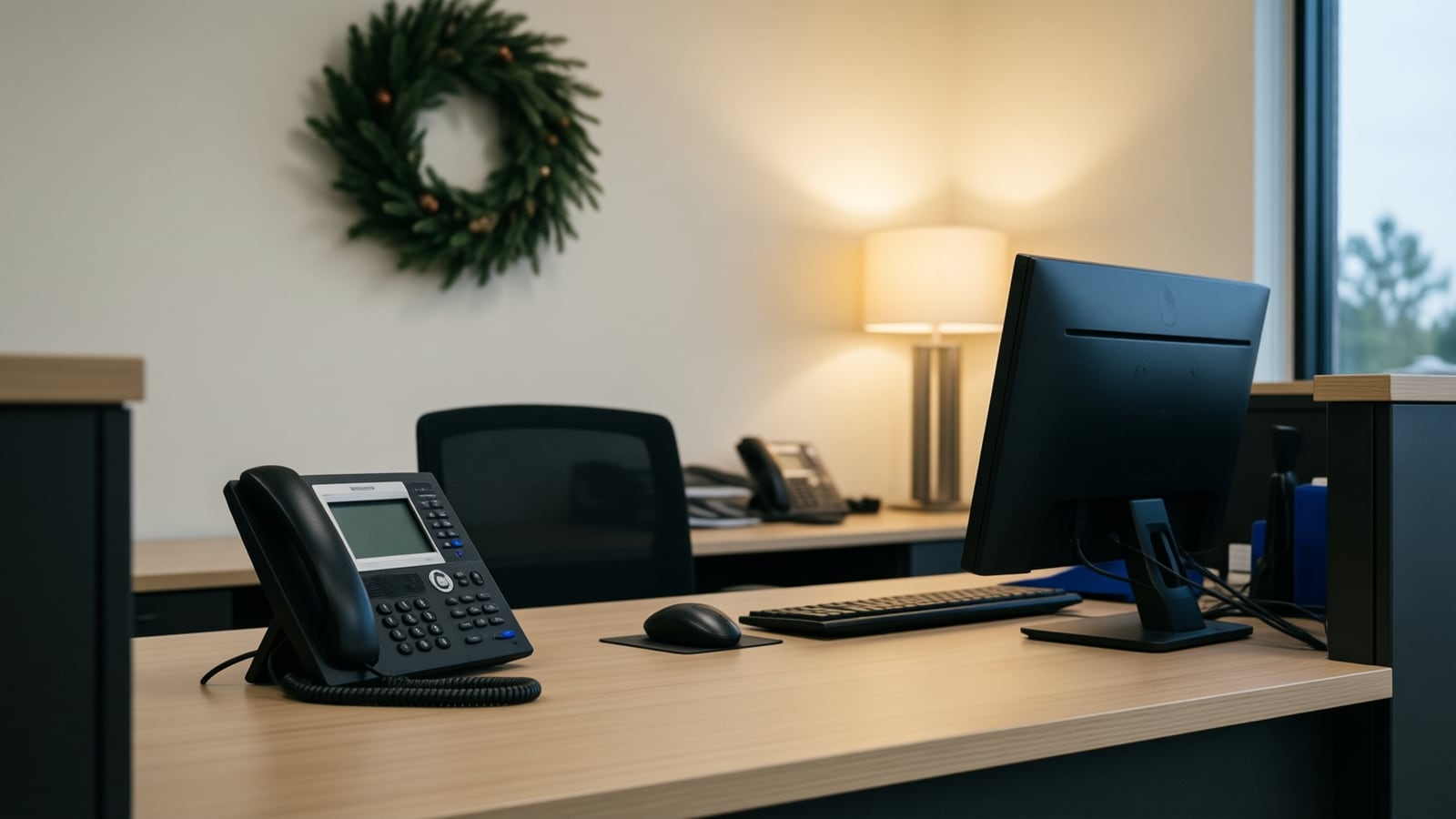
A holiday voicemail greeting tells callers the office is closed, when it reopens and what to do if the matter cannot wait. A good one is short, scheduled by date so it switches itself on and off, and backed by a real path for urgent calls. This guide gives scripts, the scheduling logic and four ways to cover the phones.
What should a holiday voicemail greeting say?
If you would rather start from a finished draft, our free voicemail and auto attendant greeting generator writes a holiday closure greeting, an after-hours greeting and a voicemail greeting from a few answers, in English and Spanish. The rules below explain what it puts in and why.
A closure greeting has five jobs, in this order:
- Say who the caller reached. The business name, first, so a caller who misdialed can hang up.
- Say you are closed and why. "Closed for the holiday" is enough. Naming the holiday is optional.
- Say when you reopen. A day and a time. This is the detail callers want most and the one most often left out.
- Offer the urgent option early. Before "leave a message", not after it. A caller with a real problem should not have to sit through the whole recording.
- Say what happens to a message. When it will be heard and when to expect a call back.
Leave out the things that go stale: the year, a staff member's name, a promotion. A caller should be able to take in the whole greeting on one hearing, and the reopening day should be easy to catch.
What do good holiday greeting scripts sound like?
Three short scripts cover most offices. Replace the bracketed words with your own.
Single-day closure, main line:
Thank you for calling [business name]. Our office is closed today for the holiday and reopens [day] at [time]. If this is urgent, press one now to reach our on-call team. Otherwise, please leave your name, number and a short message, and we will call you back on [day].
Extended closure between the holidays:
You have reached [business name]. Our office is closed for the holidays from [first day] through [last day], and we reopen [day] at [time]. For urgent service, press one. To leave a message for our team, stay on the line. Messages are returned in the order received once we reopen.
Reduced hours, not closed:
Thank you for calling [business name]. During the holiday week our hours are [hours], [days]. To leave a message, press two. For an urgent matter outside those hours, press one.
Record them in a quiet room, in one calm voice, slightly slower than normal speech. If you serve Spanish-speaking customers across Orange County, record a Spanish version and offer it in the first sentence, not at the end.
How does a holiday schedule switch the greeting on and off?
The common mistake is recording the holiday message over the everyday greeting, then forgetting to change it back. Every January, some offices are still "closed for the holidays" in the second week of the month. The fix is to let the phone system do it by date.
Holiday schedule: a list of dates and times, stored in the phone system, during which calls follow closure rules instead of the normal business-hours rules. Each entry has a start and an end, and can carry its own greeting and its own routing. When the entry ends, the system returns to the regular schedule without anyone touching it.
Business phone systems handle this in much the same way, though the menus differ. Three examples from vendor documentation, as of November 2026:
- Nextiva. The schedule step in a call flow splits calls into an open branch and a closed branch, and holidays override regular business hours. Holidays can be picked from a list of observed holidays, entered as specific dates and times, or set as a recurring day such as the first Monday of a month.
- Microsoft Teams Phone. Holidays exist to give callers alternate messages and routing while the organization follows a holiday schedule, and up to 50 dates and times can be combined into one holiday set. For a full-day closure, Microsoft's setup steps say to end the holiday at 12:00 AM on the following day.
- Yeastar P-Series. A holiday can be created by date, by month, by week or by weekday, each with its own prompt. The same page notes that the prompt only plays if the "Play Holiday Prompt During Holidays" option is enabled on the inbound route, which is exactly the kind of setting a test call catches.
Which days to enter is your decision. The federal calendar is a useful reference: the Office of Personnel Management's federal holiday schedule lists Thanksgiving Day on Thursday, November 26 and Christmas Day on Friday, December 25 in 2026, with New Year's Day falling on Friday, January 1, 2027. That schedule applies to federal employees; a private office picks its own closures, including the day after Thanksgiving and early closings on the eves, and each one needs its own entry.
The auto attendant is where the holiday greeting usually plays, and the wider set of rules that send calls to one place or another by hour and date is call routing. The holiday schedule is one of those rules, and it should outrank the weekly one.
What should an urgent caller hear during a closure?
Decide what "urgent" means before you record anything. For a dental practice it may be pain or swelling. For a property manager it is water or a lockout. For an IT firm it is a client whose systems are down. For many offices, honestly, nothing is urgent, and the greeting can say so by giving the reopening day and nothing more.
If something is urgent, the caller needs three things: an option early in the greeting, a destination that a person actually answers, and a fallback if that person does not pick up. An on-call mobile that rings out to a personal voicemail greeting is worse than no option at all. Our guide to after-hours call handling options covers the on-call path in more detail.
Who covers the phones while the office is closed?
There are four practical ways to cover a closure, and many offices combine two of them.
| Option | What the caller gets | What it cannot do | Best fit |
|---|---|---|---|
| Holiday greeting and voicemail | Closure dates, reopening day, a place to leave a message | Answer a question, book, or spot an emergency | Offices with no urgent calls |
| Forwarding to a mobile | A person who knows the business | Take two calls at once; gives one person no time off | Small teams with rare urgent calls |
| Live answering service | A person reading your script, messages taken, on-call paging | Usually cannot see your calendar or systems | Regulated or high-touch calls |
| AI receptionist | Natural conversation, routine answers, bookings for the reopening week, emergency handoff | Handle matters outside its rules; needs setup and testing | Offices that lose business when calls go unanswered |
Voicemail is the baseline and costs nothing extra. Forwarding works for a long weekend and wears thin over a two-week closure. An answering service and an AI voice agent both keep a closed office reachable; the difference is that the agent can be connected to the calendar, so a caller on Christmas Eve can book the first open slot in January instead of leaving a message. If either one records calls, callers need to be told at the start. Our call recording and AI agent notice generator produces the wording and lists the California sources behind it; confirm the final text with your attorney.
How do you set it up before the last working day?
- List every closure and early closing for the season, with start and end times.
- Write the greeting and read it aloud once. Cut anything a caller does not need.
- Record it and upload it to the phone system as a separate prompt. Do not overwrite the everyday greeting.
- Enter each closure in the holiday schedule, attach the greeting and choose the routing: voicemail, an on-call number, an answering service or an AI receptionist.
- Confirm the on-call person has agreed, has the number saved and knows what to do with the call.
- Test from an outside phone. Where the system allows it, set a short test holiday a few minutes ahead. Call the main number, listen to the whole greeting and press every option.
- Check the mailbox. Empty it, and confirm who receives the voicemail notifications during the closure.
- Update the other places callers look: the website, the Google Business Profile hours and the email auto-reply.
- Call again on the first morning back to confirm the normal greeting has returned.
Nextiva's own holiday tips end with the same reminder: switch custom greetings and call settings back to normal after the holidays. A date-based schedule does that for you; a manual change depends on someone remembering.
What mistakes do offices make every year?
- The greeting never says when the office reopens.
- The holiday message stays up into January because it replaced the everyday greeting.
- The schedule covers Christmas Day but not the afternoon before it.
- The urgent option leads to a mobile nobody is watching.
- The mailbox fills up on day three and callers hear that it cannot take messages.
- The website and the phone greeting give different reopening days.
Key takeaways
- A holiday greeting needs five things: who you are, that you are closed, when you reopen, the urgent option and what happens to a message.
- Put the urgent option before the request to leave a message.
- Use the phone system's holiday schedule so the greeting turns on and off by date.
- Enter every closure and early closing as its own entry, and test with a call from outside.
- Voicemail, forwarding, an answering service and an AI receptionist each fit a different kind of office; many combine two.
- Check on the first morning back that the normal greeting has returned.
How Telxpress helps
Telxpress is an Irvine business solutions provider and AI advisor. We install and manage business phone systems from partners including Nextiva and Yeastar, set up holiday schedules and greetings as part of that work, and build Donya, the AI voice agent that can answer while the office is closed. If the holidays showed you how many calls reach nobody, start with the greeting generator, then talk to us about what should answer next year.
Questions
Questions this article answers
What should a holiday voicemail greeting for a business say?
Say the business name, that the office is closed for the holiday, the day you reopen, and what the caller can do now: leave a message, use the website, or press a key for urgent help. Add when messages will be returned. Keep it short enough to hear once without losing the caller.
How do I schedule a holiday greeting so it turns on and off by itself?
Use the holiday schedule in your phone system rather than recording over the daily greeting. You enter each closure with a start and an end, attach the holiday greeting and a routing choice, and the system plays it only inside those dates. When the closure ends, the normal greeting returns without anyone logging in.
Should we name the holiday in the greeting?
It is optional. A greeting that says the office is closed for the holiday and gives the reopening day works for every closure in the season and for every caller. Naming the holiday sounds warmer but means one recording per closure. If you name it, schedule each recording to its own dates.
What should urgent callers hear when the office is closed?
They should hear a clear option early in the greeting, before the request to leave a message. Define what counts as urgent for your business, offer one key or one number, and send it to a person who has agreed to be on call. Test that path before the closure and again during it.
Can an AI receptionist answer the phones during a holiday closure?
Yes. An AI receptionist can answer in natural speech, give the holiday hours, answer routine questions, book an appointment for the week you reopen and pass a true emergency to the on-call person. It still needs your rules, your calendar and a tested handoff, and callers should be told they are speaking with an AI assistant.
Keep reading
Related articles
- Business Technology November 23, 2026

UCaaS Explained for Business Owners: What It Bundles and When It Fits
Phones, meetings and chat on one subscription sounds simple, but the value depends on what you already pay for and how ready your network is.
- Business Technology November 19, 2026
What Happens to a Cloud Phone System When the Internet Goes Down?
An internet outage does not have to mean dead air: the provider keeps answering in the cloud, and a tested plan decides where each call lands next.
- Business Technology November 16, 2026
What Is a PBX Phone System? On-Premises, IP and Cloud PBX Compared
The box in the phone closet, the server on the network and the monthly cloud subscription are all called a PBX, and the differences decide who fixes it when it breaks.