The Undertaker Who Took the Operator Out of the Telephone Call
The automatic telephone exchange began with a businessman who stopped trusting the person who routed his calls, and his complaint is still the right way to judge an office phone system.
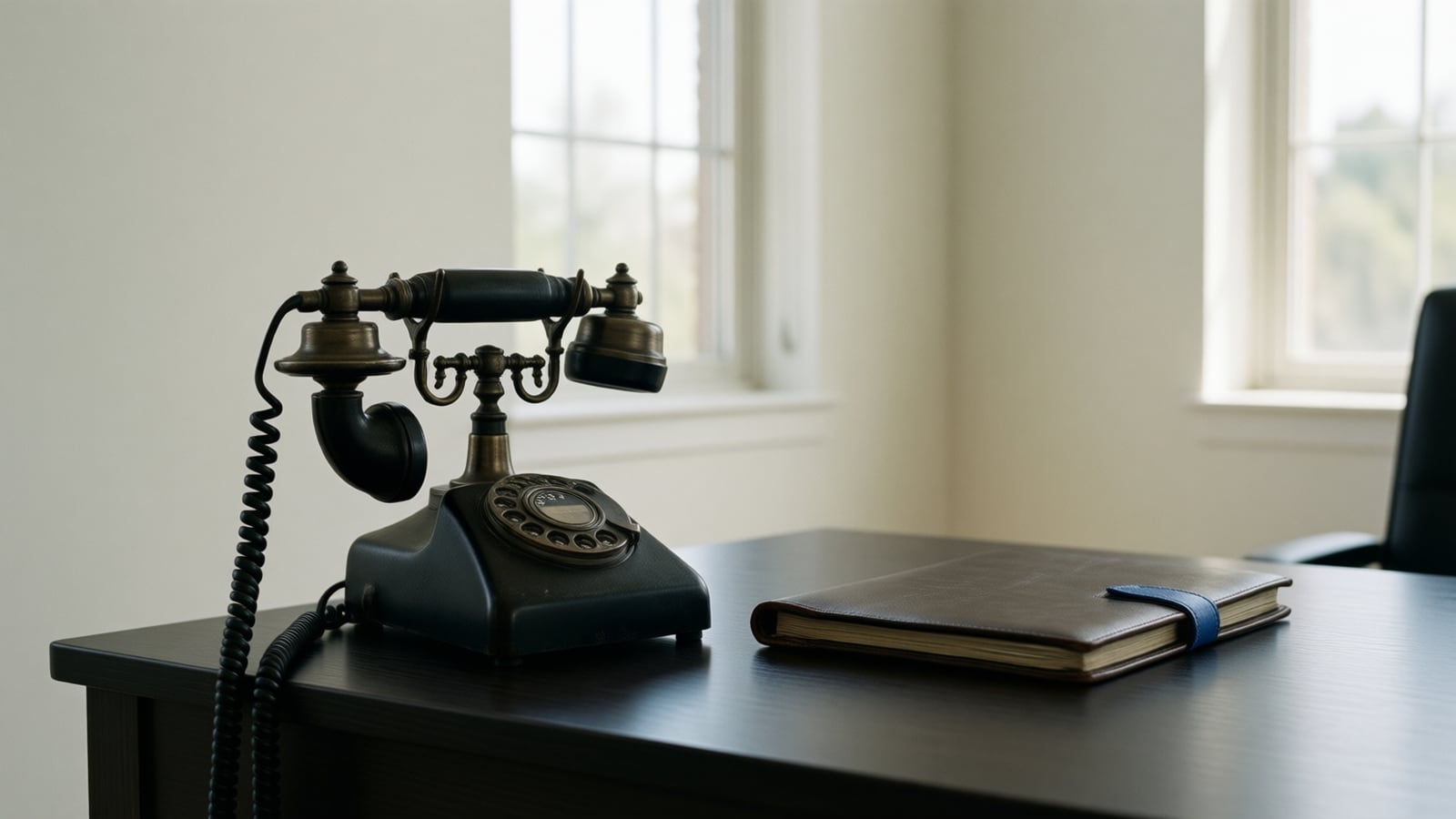
The first automatic telephone exchange to work in commercial service came from Almon Brown Strowger, an undertaker in Kansas City, Missouri, who believed the local operator was sending his callers to a competitor. He applied for a patent in 1889, received it on March 10, 1891, and opened an exchange with no operator in La Porte, Indiana, on November 3, 1892.
Who was Almon Strowger?
Strowger was born in Penfield, New York, in 1839, moved west to Kansas and worked as an undertaker. The Kansas Historical Society notes that he was living in Kansas City, Missouri, when he applied for the patent, and the patent itself agrees: it describes him as residing at Kansas City, in the county of Jackson.
He was not an engineer. A reference history of the invention published by EBSCO says plainly that he lacked technical training. What he had was a business that could lose a customer to one misdirected call, and a growing suspicion about the people who handled his calls.
Why would an undertaker want to get rid of the operator?
In the 1880s nobody dialed. A caller signaled the exchange, an operator answered, and the operator connected the call by hand to the line that was asked for. For a funeral business, a call that ended up at the wrong parlor was a customer gone for good.
The story of what set Strowger off comes in three versions, and the honest answer is that nobody can prove which is right. MIT Technology Review says the details are in dispute, but that most historians agree he suspected callers who asked for his mortuary were being connected to his competitors. The Kansas Historical Society tells the sharpest version: the operator was married to the other undertaker. The Engineering and Technology History Wiki calls it a commonly told story and gives a third variant, in which he learned that a friend's funeral was being handled by a rival.
Whichever happened, the patent states his aim without any drama. The object of the invention, in the words of U.S. Patent 447,918, was to let a person at one station connect with any other station "without the assistance of an operator at the central station."
Strowger switch: an electromechanical telephone switch, also called a step-by-step switch, that connects a call one digit at a time by moving a contact arm to the called line as the caller signals each digit, with no operator involved.
How did the first automatic exchange work?
The first model was built from what an undertaker had at hand. MIT Technology Review describes a prototype made from a cardboard collar box, with a 10-by-10 grid of pins standing for 100 line terminals and a pencil as the rotating shaft.
The patented design had no dial. Each telephone had keys and a push button, and the caller pressed them the right number of times to step the switch to the line they wanted. The EBSCO history describes two buttons that could be pressed up to nine times each, enough to signal any two-digit number in a system built for up to ninety-nine telephones. To reach line 37, a caller pressed one button three times and the other seven times.
It asked the caller to count. It also did something no switchboard could: it connected the call the same way every time, for every caller, without anyone choosing.
What happened in La Porte, Indiana?
On November 3, 1892, Strowger and his business partners opened the Strowger Automatic Telephone Exchange in La Porte, Indiana, according to MIT Technology Review. The EBSCO history calls it the first automatic central switching facility in the world.
The idea was Strowger's. The equipment that made it dependable came from the engineers who joined him. Alexander Keith, John Erickson and Charles Erickson developed the switch into a workable commercial system, and in 1896 the three of them invented the dial telephone, which replaced the buttons with a finger wheel.
Did Strowger get rich?
He did not. MIT Technology Review reports that he sold his patents for $1,800 and his stake in the company for $10,000, and retired to Florida six years after opening the first exchange. The Kansas Historical Society adds that he moved to St. Petersburg in 1898 and went back to the undertaking business until he died in 1902.
The big money arrived after him. In 1916, by MIT Technology Review's account, the Bell System licensed his invention for $2.5 million. The first Bell step-by-step switch entered service in Norfolk, Virginia, in 1919, and the Engineering and Technology History Wiki records that the Strowger switch remained the most widespread switch in use until the 1960s.
| Year | What happened |
|---|---|
| 1839 | Almon Brown Strowger is born in Penfield, New York |
| 1889 | He files his patent application on March 12 |
| 1891 | U.S. Patent 447,918 is granted on March 10; the Strowger Automatic Telephone Exchange is set up |
| 1892 | The first commercial automatic exchange opens in La Porte, Indiana, on November 3 |
| 1896 | Keith, John Erickson and Charles Erickson invent the dial telephone |
| 1898 | Strowger sells his patent and shares and moves to Florida |
| 1902 | Strowger dies |
| 1916 | The Bell System licenses the invention |
| 1919 | The first Bell step-by-step switch enters service in Norfolk, Virginia |
| Until the 1960s | Step-by-step remains the most widespread telephone switch in use |
Quick facts
- The patent took two years: filed March 12, 1889, granted March 10, 1891, as the patent's own header records.
- Strowger was not the first to patent an automatic switch. A design patented in 1879 specified one and failed in practice, the EBSCO history notes.
- The first prototype used a collar box, pins and a pencil, by MIT Technology Review's account.
- The original telephones had push buttons. The dial came five years after the patent, from the engineers Strowger hired.
- The Bell System did not put a step-by-step switch into service until 1919, per the Engineering and Technology History Wiki.
What it means for your business today
Strowger's complaint was never about technology. It was that someone else decided where his callers went, and he could not see it happening. Every business with a phone number has the same exposure, and as of November 2026 the tools for closing it are far better than a collar box.
Three checks take an afternoon:
- Write down where calls go. Who answers first, what happens when every line is busy, and what a caller hears at 5:05 PM or on a Saturday. That map is your call routing, and on a modern system it lives in the auto attendant and its schedules, not in anyone's head.
- Read the record. A current business phone system logs every call as answered, missed, abandoned or sent to voicemail. Strowger had to guess. You can count, and the missed-call cost calculator turns the count into money.
- Call yourself the way a customer would. At lunch, after hours and during your busiest hour. The call that reaches nobody is the one a competitor answers.
Where the answer is "nobody picks up," the modern version of Strowger's fix is an AI receptionist. Donya, the voice agent we build and run, answers every call, follows the routing rules you approve and leaves a transcript of each one, so the question of where a caller went always has an answer. If you are weighing that against a live service, the virtual receptionist comparison lays out both.
Key takeaways
- The automatic telephone exchange was patented in 1891 by Almon Strowger, an undertaker, not an engineer.
- His reason, by most accounts, was distrust: he believed an operator was steering his callers to a competitor. The details are disputed.
- The first commercial exchange opened in La Porte, Indiana, on November 3, 1892, with push buttons instead of a dial.
- Engineers Alexander Keith, John Erickson and Charles Erickson made the system dependable and invented the dial in 1896.
- Strowger sold out cheaply and died in 1902; his switch stayed the most widespread in use until the 1960s.
- The lesson holds: know where your calls go, check the record, and test your own number like a customer.
Questions
Questions this article answers
Who invented the automatic telephone exchange?
Almon Brown Strowger, an undertaker living in Kansas City, Missouri, patented the first automatic telephone exchange to reach commercial service. He applied in March 1889 and the patent was granted on March 10, 1891. Engineers who joined him, among them Alexander Keith, John Erickson and Charles Erickson, turned the idea into dependable equipment.
Why did an undertaker invent the automatic telephone exchange?
The common account is that Strowger suspected the local operator of connecting people who asked for his funeral business to a competitor. Historians say the details are disputed, and one version adds that the operator was married to the rival undertaker. What is documented is his patent, whose stated aim was connecting calls without an operator.
What is a Strowger switch?
A Strowger switch, also called a step-by-step switch, is an electromechanical device that connects a telephone call one digit at a time, moving a contact arm to the right line as the caller signals each digit. It replaced the human operator for local calls and stayed the most widespread switch until the 1960s.
When did the first automatic telephone exchange open?
The first commercial automatic exchange opened in La Porte, Indiana, on November 3, 1892, run by Strowger and his business partners. Callers signaled the number with push buttons, because the rotary dial had not been invented yet. The dial arrived in 1896, designed by engineers at the same company.
Did Almon Strowger invent the rotary dial?
No. His 1891 patent describes keys and a push button at each telephone, pressed the right number of times to reach a line. The dial telephone was invented in 1896 by Alexander Keith, John Erickson and Charles Erickson, the engineers who developed his switch into a commercial system.
Keep reading
Related articles
- Business Technology November 23, 2026
UCaaS Explained for Business Owners: What It Bundles and When It Fits
Phones, meetings and chat on one subscription sounds simple, but the value depends on what you already pay for and how ready your network is.
- Business Technology November 19, 2026
What Happens to a Cloud Phone System When the Internet Goes Down?
An internet outage does not have to mean dead air: the provider keeps answering in the cloud, and a tested plan decides where each call lands next.
- Business Technology November 16, 2026
What Is a PBX Phone System? On-Premises, IP and Cloud PBX Compared
The box in the phone closet, the server on the network and the monthly cloud subscription are all called a PBX, and the differences decide who fixes it when it breaks.